
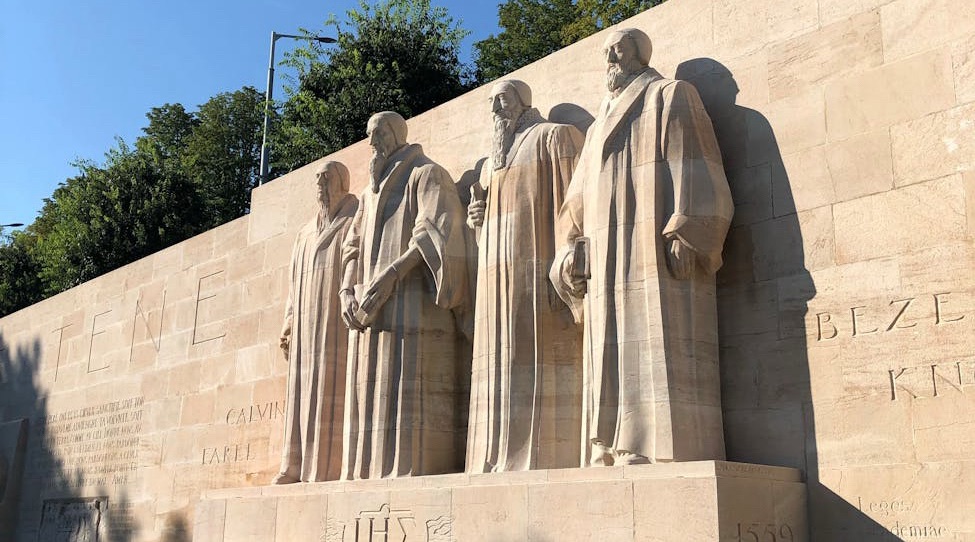
The accusation from Roman Catholics, especially online these days, is that Protestants broke away from the Roman Catholic Church and started something new. The accusation makes it seem as if Protestants broke away from the Ancient Church to form something novel. And most often, Protestants don’t know what to say in response to this. They just sort of shrug it off and go on.
Another way this is framed by Roman Catholics is by saying that if Protestants would only read Church History, they’d be Roman Catholic.
Both statements are not just false, but they are false in a way that’s hilariously and obviously provable. They are false in a way akin to when a child covered in mud tries to argue that they’re not covered in mud. It’s just wrong on its face…and it’s obviously so.
Protestants weren’t trying to start something novel. A fair reading of church history proves that. They were trying to move toward greater faithfulness to the ancient faith. They believed themselves to be returning to ancient Christianity. And I believe all evidence points to them having, in large part, done so.
I want to write about this one thing today. And I want to do this by looking at one event in history that helps to enlighten the Reformation’s intentions. It’s when Sadolet attempted to bring Geneva back to Roman Catholicism.
The Protestant Reformers Didn’t Think They Were Starting Something New
I took Church History courses and contemplated getting my PhD in Church History. I greatly enjoyed it. One of my favorite classes was over the work of John Calvin and his influence on the Reformation.
Calvin was not a Protestant when the Reformation began. He was young and Roman Catholic. He converted sometime around 1533 when he was 24 while studying to be a lawyer. But this second generation Reformer became the foremost thinker of the Reformation. By the age of 26 he had published the first edition of his work, Institutes of the Christian Religion, which underwent massive edits through the years.
Read Martin Luther and you’ll see interactions with Church History. You’ll read interactions with the Early Church Fathers. But read Calvin and you’ll get a monster dose of these things in a constant flow. Calvin quoted Augustine over 1700 times in his writings…just Augustine.
He did this for two reasons. First he wanted to argue with the Roman Catholics and show how Protestants conformed to historic church teaching. And second, the Reformers as a whole, believed themselves to be going back to something that the Roman Catholic Church had left behind. The Roman Catholic Church had moved away from the primitive Church and its teachings, therefore they believed it was necessary to either bring reformation to the Roman Catholic Church or reject it.
In other words, they believed themselves to be more in line with primitive. Christianity. They weren’t trying to make something new. They were attempting to conform to the old. They were returning to Christian roots.
This comes out plainly in Calvin’s “Reply to Sadoleto”.
This book is an interesting one. And anyone that’s interested in the Reformation era should read it.
In 1539 John Calvin and William Farel had been kicked out of Geneva over church governance issues. The city government was mandating Lord’s Supper frequency and Calvin disagreed with them. The city responded by kicking them out. It all seems so strange today, but back then state and church governance were that intertwined, and oftentimes it was strange. It’s just hard to imagine a city kicking pastors out for this reason, but it happened.
With Calvin and Farel gone a Roman Catholic Cardinal and Bishop of Carpentras saw an opportunity to bring Geneva back to Roman Catholicism. His name was Jacopo Sadoleto. Sadoleto wrote a letter to the city magistrates and citizens of Geneva calling for them to abandon their Protestant Faith and return to Rome.
Because Geneva’s local government had kicked out the two men best suited to answer the letter, they didn’t know what to do. So they sent word to John Calvin, who was in Strasbourg, and asked him to answer.
Calvin did reply to Sadolet’s letter. And you can read the letter he sent back to Sadolet here. There is much in the letter concerning the authority of the Scriptures and justification. It’s well written and I appreciate his thorough response to Sadolet and the light it shines on the Reformation era. But I am only discussing what the Reformers believed their selves to be doing, and that is returning to the ancient faith.
Notice what Calvin writes in the letter’s response.
You know, Sadolet, and if you venture to deny, I will make it palpable to all that you knew, yet cunningly and craftily disguised the fact, not only that our agreement with antiquity is far closer than yours, but that all we have attempted has been to renew that ancient form of the Church, which, at first sullied and distorted by illiterate men of indifferent character, was afterwards flagitiously mangled and almost destroyed by the Roman Pontiff and its faction.” (John Calvin, Reply to Sadoleto)
Calvin’s remarks here are poignant. He is confident that Sadolet knows that the Reformers are closer to ancient Christianity than Rome. And his point is clear. It is one thing to claim that you are the ancient form of Christianity. It is quite another to actually fall in line with the ancient practices of the Christianity.
Sullied and Distorted
The Protestant Reformers believed that the Roman Catholic Church had distorted the teachings of Christianity. Here, Calvin speaks a word that is heard repeatedly in that era. The development of beliefs and practices over the course of over 1500 years had not improved upon Christianity, for that could never happen. Any change would be for the worse.
God gave to us His Word. The Scriptures contain everything needed for a life of godliness.
“All Scripture is breathed out by God and profitable for teaching, for reproof, for correction, and for training in righteousness, that the man of God may be complete, equipped for every good work.”
2 Timothy 3:16-17 ESV
The Scriptures, that is the Old and New Testament, are from God. A person can be reproved, corrected, and trained by them. And in them the Christian is equipped for EVERY good work.
The logic is clear here. How can a church change its practices and beliefs over time and get better than what Paul said Timothy had in 2 Timothy 3:16-17?
The obvious answer is that it can’t happen. Any move away from that is sullying and distorting.
Calvin’s Confidence, Mine, and Hopefully Yours Too
Why do I believe that Protestantism is a return to the ancient ways?
Can I even have confidence that this is the case?
Calvin’s confidence in the ancient practices of the Church is based upon what we find in Scripture. We tend to think of the Scriptures and the ancient church as being separate, but they’re not. Most of the New Testament details what was taking place in the Early Church.
The letters of Paul were not just written to be added to the pages of Scripture. They were letters written to a local church or group of churches in their infancy or to pastors who were leading these churches. Peter and John wrote letters that were intended to go to multiple churches in their infancy. The Book of Acts details the birth of many of these churches as the gospel expanded and often gives us insight into how they operated.
In other words, we don’t have to make things up as we go. We have the practice of the Early Church in the pages of Scripture. For the most part, we know what they did.
Do other works from the Early Church benefit us? Of course they do.
I can glean much from those early writings. I can see an early application of the Scriptures in The Didache and the letters of Clement. It can help me to understand how the Church faced a changing world. It can help me to see the conquest of the gospel into many places around the globe. I can be moved as I read of the past faithfulness of saints in the face of persecution such as the account of Polycarp’s death.
But in church history I can see many mistakes made. I can see heretical deviations from Scripture and how the Church responded to it.
I can see clarity on certain doctrines as they take shape due to controversies. As people were pressed on issues they came together and studied God’s Word in great detail and fought over the meaning of it. You wouldn’t understand the Doctrine of the Trinity or the Hypostatic Union (that Jesus is fully God and fully man).
But what is the final authority on all these things?
It is Scripture. We judge the rightness and wrongness of these things by God’s Word. It is the standard. And we see how the church is to be ordered within God’s Word. We see what we are to believe in God’s Word.
Extra-biblical church history can help me to understand and apply God’s Word better. But God’s Word is that final authority. And in His Word we see the Church in her infancy, taught by the Apostles, corrected by the Apostles, growing in the Lord.
We didn’t start something new. We can look at the testimony of Scripture and see that the Protestant Reformation was a move toward antiquity.


Leave a Reply