
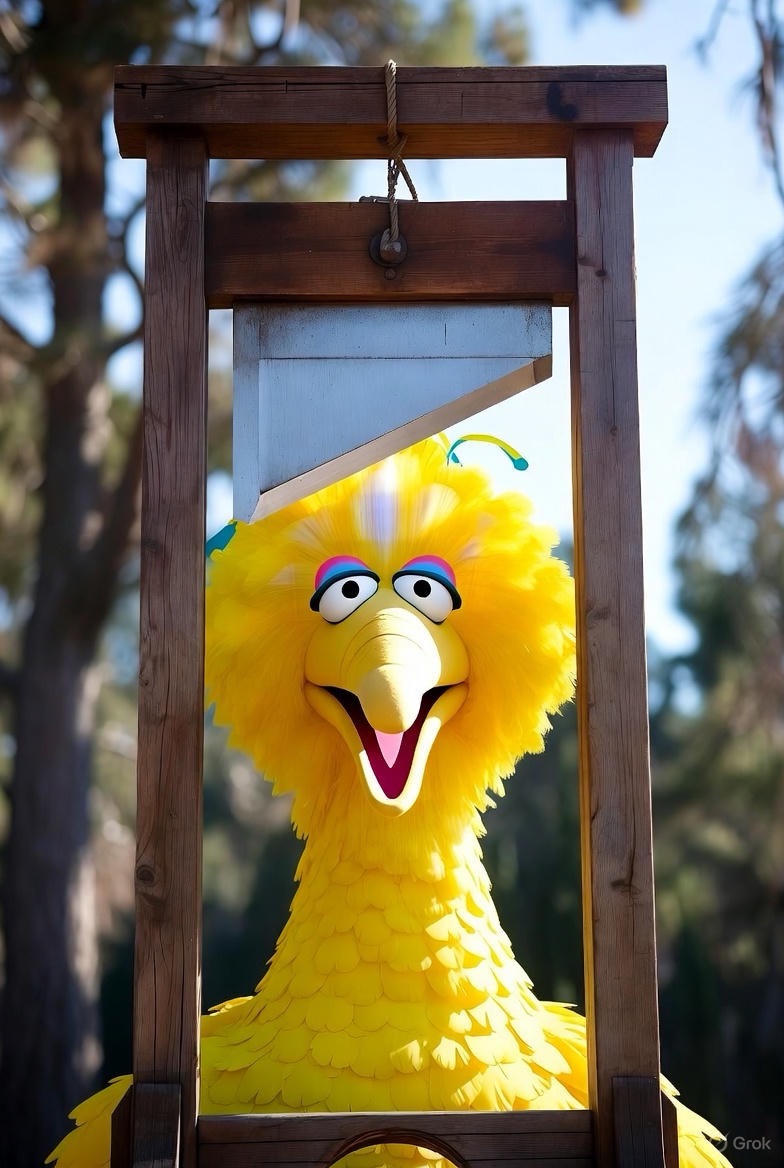
If you had the opportunity to kill Big Bird when he was just a fleeting thought in the 1960’s, would you do it? Or would you allow Sesame Street to grow to adulthood and even old age and allow it to damage generations of children? What do you think is the right thing to do?
I watched Big Bird as a kid. It was fun, wholesome television that taught children through entertainment. But this is just the problem with Sesame Street according to Neil Postman back in 1985. And as Big Bird faces death, I thought it would be interesting to pull a few ideas from Neil Postman to see why the whole education through entertainment thing was a bad idea all along.
Amusing Ourselves To Death
The book is titled “Amusing Ourselves to Death” and it is a fitting title. For the whole idea is that the entertainment of television, and I suppose that if he were alive today he would include all sorts of things that we watch on our phones, inadvertently infects other parts of life. Another way of putting it is that the tools we use shape us more than we realize. So we should be wary of how we use those tools.
In one of the beginning paragraphs we read,
“Today, we must look to the city of Las Vegas, Nevada, as a metaphor of our national character and aspiration, its symbol a thirty-foot-high cardboard picture of a slot machine and a chorus girl. For Las Vegas is a city entirely devoted to the idea of entertainment, and as such proclaims the spirit of a culture in which all public discourse increasingly takes the form of entertainment. Our politics, religion, news, athletics, education and commerce have been transformed into congenial adjuncts of show business, largely without protest or even much popular notice. The result is that we are a people on the verge of amusing ourselves to death.” (Neil Postman, Amusing Ourselves to Death, 20th Anniversary Edition, 2005 p. 4)
He saw all of life being turned into show business. The television shaped everything. And now we would say that the modern cell phone is shaping everything even more. And, in his view, it was walking us toward our death.
The first edition of this book was written when I was 3 years old. And it is obvious enough that America did not heed his warnings, for I grew up in an era dominated by the television. And it is obvious as one reads his book. The things that he discussed throughout the book are far worse today than they were when he first wrote it.
And herein lies the difference. Television was pushing out the culture of print. And it was replacing print with something else altogether.
“In a culture dominated by print, public discourse tends to be characterized by a coherent, orderly arrangement of facts and ideas. The public for whom it is intended is generally competent to manage such discourse. In a print culture, writers make mistakes when they lie, contradict themselves, fail to support their generalizations, try to enforce illogical connections. In a print culture, readers make mistakes when they don’t notice, or even worse, don’t care.” Ibid p. 51
I find this amusing because today we long for the culture of print without wanting to do the work of being a print culture. We mock people for not being able to think through an argument, but it’s our own fault. We gave up being a print culture long ago. And we gave up coherent and orderly arrangements of facts and ideas for entertainment. We embraced entertaining incoherence a lot time ago.
We live in an era filled with illogical connections, lies, and contradictions. And later in the book he argues that Western democracies would “dance and dream themselves into oblivion because of it. That is the very thing that is happening today. And if you’ve read Huxley’s “Brave New World” and Orwell’s “1984” you’ll catch all the references.
“All that has happened is that the public has adjusted to incoherence and been amused into indifference. Which is why Aldous Huxley would not in the least be surprised by the story. Indeed, he prophesied its coming. He believed that it is far more likely that the Western democracies will dance and dream themselves into oblivion than march into it, single file and manacled. Huxley grasped, as Orwell did not, that it is not necessary to conceal anything from a public insensible to contradiction and narcoticized by technological diversions. Although Huxley did not specify that television would be our main line to the drug, he would have no difficulty accepting Robert MacNeil’s observation “Television is the soma of Aldous Huxley’s Brave New World.” Big Brother turns out to be Howdy Doody.” Ibid p. 111
For Postman, television was not bad in itself. But it needed to stay in its lane. It’s lane was narrowband its usage needed to be narrow, otherwise it could be incredibly damaging.
“Television, as I have implied earlier, serves us most usefully when presenting junk entertainment; it serves us most ill when it co-opts serious modes of discourse-news, politics, science, education, commerce, religion-and turns them into entertainment packages.” p. 159
His argument is that television and its successors are not good for “serious modes of discourse”. But that is exactly what we have done with them. In America everything has been shaped by these mediums.
Politics
Barrack Obama, Donald Trump, and Zohran Mamdani are all predicted by Postman in this book. It’s not because he made predictions about the men themselves, it’s just that he understood something that was happening due to America shifting from a print culture to an entertainment culture.
“In the shift from party politics to television politics, the same goal is sought. We are not permitted to know who is best at being President or Governor or Senator, but whose image is best in touching and soothing the deep reaches of our discontent.” Ibid p. 135
It is no longer the case that we elect presidents based upon what they believe. We now vote on them based on “whose image is best in touching and soothing the deep reaches of our discontent”.
All of the men I listed above, and many more, did that to get elected. They were people who reached their audience, not because of the content of their message but because they were able to soothe the discontent of their base in some way shape or form.
Listen, if you’ve read me much at all then you know that I have liked much of Donald Trump’s policies. But I am not blind to the fact that he was elected because of the discontent of the people. In an age of entertainment, I believe he was best able to harness that to win his office twice. The same sort of thing happened when Obama ran on “Hope and Change”. And it happened with Mamdani in this New York City election.
In days gone by people could have walked by the President of the United States and not recognized him. They would have known what he believed and would do based on his discourse. I do not believe that these three men would have been elected in a non-entertainment era.
And it’s not just the presidency that has been affected. A majority of those in congress don’t have the ability to do the serious task of governing anymore. They do little more than try to grab attention on Social Media. Their investigations are little more than campaign fund grabs.
Television and now the cell phone and all that encompasses has drastically changed politics. I am not even sure that the serious politician even exists anymore. Gone are the days of substantive discourse. And today is the day of viral clips as Senators, who are supposed to be members of the world’s greatest deliberative body, try to make the most catchy moment they can for Tic Toc.
I believe that would be the epitome of amusing ourselves to death.
Christianity
Postman lamented the television preacher and what he did to Christianity. In his assessment, the television preacher influenced the pulpit and created an easy and amusing experience that is foreign to Christianity. The deep thought of men like Jonathan Edwards was replaced by the shallow messages of Robert Schuller.
“I believe I am not mistaken in saying that Christianity is a demanding and serious religion. When it is delivered as easy and amusing, it is another kind of religion altogether.” Ibid p. 121
And I do not believe that he is wrong here. I would also add that modern technology has only made matters worse.
On Sunday, in churches across America, there will be an easy and entertaining church service complete with just the right lighting and sound. It will be followed by an easy and entertaining message.
How many times have you lamented along with Postman that the entertainment culture has so affected Christians in America that it seems like “another kind of religion altogether”.
Education
Now, to Big Bird. And I think that you’ll see Postman’s problems with Sesame Street and other educational shows is very similar. Television turned education into entertainment rather than work.
“We know that “Sesame Street” encourages children to love school only if school is like “Sesame Street.” Which is to say, we now know that “Sesame Street” undermines what the traditional idea of schooling represents. Whereas a classroom is a place of social interaction, the space in front of a television set is a private preserve. Whereas in a classroom, one may ask a teacher questions, one can ask nothing of a television screen. Whereas school is centered on the development of language, television demands attention to images. Whereas attending school is a legal requirement, watching television is an act of choice. Whereas in school, one fails to attend to the teacher at the risk of punishment, no penalties exist for failing to attend to the television screen. Whereas to behave oneself in school means to observe rules of public decorum, television watching requires no such observances, has no concept of public decorum. Whereas in a classroom, fun is never more than a means to an end, on television it is the end in itself.” Ibid p. 143
Did you catch the problem with Big Bird? Postman saw that Sesame Street and other shows like it have made fun the goal rather than learning. Therefore, it cannot be called an “ally of the classroom”. In reality, it was quite opposed to all that took place in the classroom.
“If we are to blame “Sesame Street” for anything, it is for the pretense that it is any ally of the classrooom. That, after all, has been its chief claim on foundation and public money. As a television show, and a good one, “Sesame Street” does not encourage children to love school or anything about school. It encourages them to love television.” Ibid p. 144
I think we all see the results of this today. We look around and are astounded by the fact that people can’t think. Well, why do we think that is? And in 1985 Postman was already discussing the research that stated television did not help matters any.
“In other words, so far as many reputable studies are concerned, television viewing does not significantly increase learning, is inferior to and less likely than print to cultivate higher-order, inferential thinking.” p. 152
Conclusion
I don’t believe that a television is bad in itself. Nor do I believe that a cell phone is. I believe they are tools. And tools have to be used in the proper manner. A hammer will drive a screw into a piece of wood. But it’s still a sorry excuse for a screwdriver.
News and politics via television has caused problems that we all lament. Social Media attention grabs through Congressional investigations is disgusting. Making Church services a form of entertainment that sluffs off the weight of worshiping God is also disgusting. And an education system so influenced by entertainment that it doesn’t really educate is also disgusting.
Now, if you could kill Big Bird when he was just a fleeting thought in someone’s brain in the 1960’s, would you do it?


Leave a Reply