
Subsidiary is not a word or principle we think through today. But it is a way that we naturally make decisions. And it’s also a biblical way of making decisions. If you don’t know what it is, you should listen to JD Vance as he argues that America First is a Christian concept.
Immediately, this clip was met with repulsion from Americans who were up in arms over it. Some were American Roman Catholic leaders, some were liberal believers, some solid Bible-believing people, and others well just were up in arms. But here is a sampling.
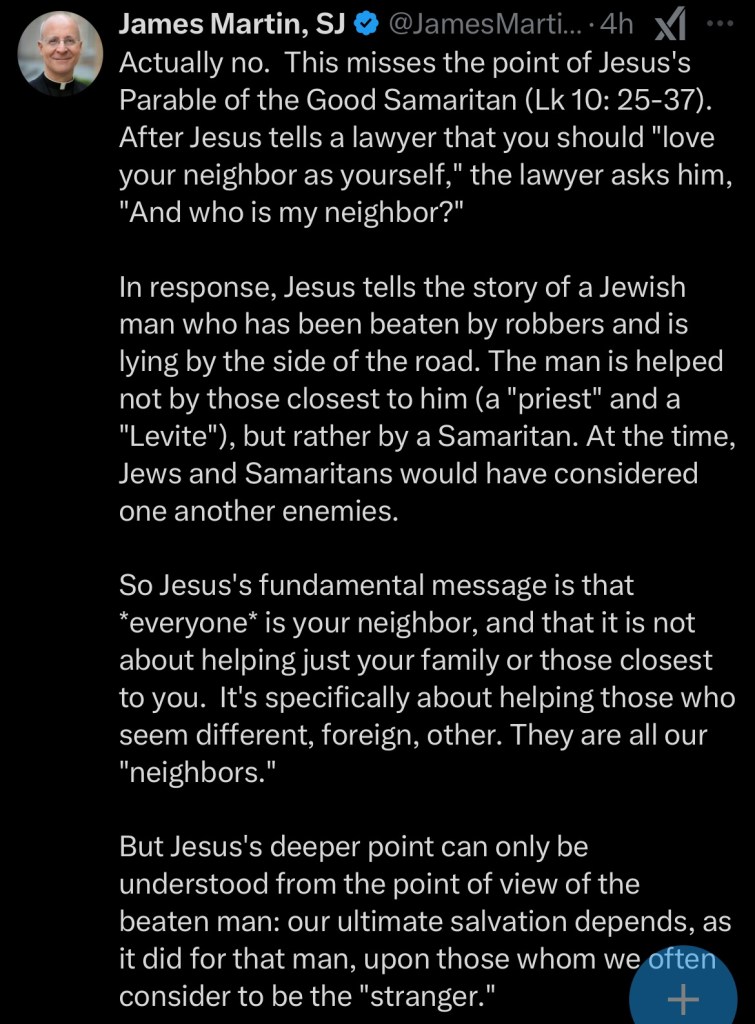


Their argument was, as you can see, that parables such as The Parable of the Good Samaritan means that we are to care for everyone, the same way, all the time. But not only is that impossible, it is not what we are called to do as Christians.
As Christians, we are called to love others. We are called to love people everywhere we go. But we are not called to love all people in the same manner. We have greater obligations to those near us than those that are far away.
This seems common sense. And it is also easy to see in Scripture as well. It does make me wonder why people are so up in arms about it.
Now, I know that Twitter is not real life. But when I see a variety of people say the same thing, it tells me there is confusion here. And there is definitely confusion here.
It very well could be that people are letting their hatred for the Trump administration flavor what they are hearing. They don’t like anything that comes out of the Trump administration, so they fight everything that comes out of the Trump administration. I don’t know. But there does seem to be some confusion here so I think I’ll spill some virtual ink on it.
I want to say that I agree with JD Vance emphatically here because I’ve read and believe the Bible. That doesn’t mean that I think he will apply the principle perfectly every time. But this is a biblical way of making decisions. And it is a way of thinking that you have probably used today.
The Bible Teaches It
The Bible teaches, rather plainly, that we are supposed to care for those closest to us first. We have a greater obligation to those near us than to those far away from us.
Notice how it is framed in Scripture.
“But if anyone does not provide for his relatives, and especially for members of his household, he has denied the faith and is worse than an unbeliever.”
1 Timothy 5:8 ESV
Paul emphasized that the Christian is to care for their family. And here is where the statement is poignant. “ESPECIALLY FOR MEMBERS OF HIS HOUSEHOLD.”
I will ask this question. Why would Paul say “especially for members of his household?” if he didn’t intend to convey that we have greater obligations to those that are nearest to us.
Notice what Paul said in the Book of Galatians. It applies this same idea to the Church and outside the Church.
“So then, as we have opportunity, let us do good to everyone, and especially to those who are of the household of faith.”
Galatians 6:10 ESV
It seems to me that Paul spells out this idea quite plainly. We are to do good to everyone, ESPECIALLY TO THOSE WHO ARE OF THE HOUSEHOLD OF FAITH”.
Why would Paul again use the word “especially” if he weren’t trying to convey that we have a greater obligation to those that are nearer to us?
You have a greater obligation to those that you are closest to. Your wife and children are to be provided for, by you, in a way that the kid in Uganda is not. There’s nothing against the kid in Uganda, it’s just that he isn’t one of your children.
Your obligation to your wife is greater than your obligation to a woman in Peru. I have nothing against women from Peru. I’m just not married to them. I’m married to my wife.
An Illustration From Church Finances
We are a small church, and because of this we have limited resources. If two people needed funds, I would lead people to prioritize the church member over the unbeliever. And I would do this because our care is “especially” for those that are part of us, in the household of faith.
Would I try to help the other person? Yes. If I could, I would in any way possible. But my first responsibility is not to them. It is to the church member. And this is an easy decision to make because they are part of the “especially” category. That prioritization is just being faithful to what is taught in Scripture.
It’s really a simple idea. I am to be concerned with my church family before I am concerned with other people. Am I to be concerned with other people? Yes. But there is a hierarchy with those closest receiving priority.
In other words, I have greater obligation to those closer in relationship to me than I am to those that are far away.
Did You Pack A Lunch For The Child Across The Globe?
The very same people that criticized Vance don’t practice what they preach. And I think that is easily proven.
If they have a family, they cared for them first. They made sure that their family’s needs were met and then concerned their selves with the needs of others. They rather naturally cared for those closest to them before they cared for those furthest away. They have an obligation to those within their family that takes priority.
I am sure that their personal lives don’t display what they were stating. It’s just nonsensical to do so.
When their child got up in the morning, they likely spent a few dollars on their breakfast. And if they were sending their child to school, they spent a few more dollars to do so. And then spent more money to feed them dinner. They provided clothing for their child to wear. They spent money to keep them warm.
They didn’t do that for a child across the city, or even across the street. Their child is their child, therefore they have a greater obligation to them.
It is quite possible that they spent some money caring for other children. Maybe they even volunteer for an organization that helps the poor. But even then, they show priority to their own children. They don’t skip work to volunteer and let their child starve.
This Applies To Other Things As Well
I believe that Social Media has made us think we are worldwide citizens, even though we are not. I am not a global citizen. I have obligations to my countrymen that I don’t have to those across the globe.
Alot of the hullabaloo is likely motivated by recent deportations and future plans for more deportations. Emotions are running high with these conversations. And, as I have argued previously, this is something that the government does and should do. It is not an obligation that individuals have on their own. Simply put, people are conflating the role of the government and the individual and making a mess of things.
But prioritizing those closest to me is a biblical principle that can and should be applied to our interactions. It is a good way to make decisions.
My greatest concern is for those that are closest to me. So, look at how this works.
I have a one flesh union with my wife, and together we have children. These people are my greatest priority. I work to keep them safe and provide for them. I have a church family that I love and care for. As a pastor, I devote much of my life to preaching and teaching the Word. And if there is an issue that comes up among them in which they need aid, I will help them to the best of my ability. I have parents. And if my parents need aid, I will help them to the best of my ability. But I shouldn’t endanger my wife and children to care for people outside my home.
There is something to keep in mind here. If you have a massive house payment and car payments and can barely afford life, then you are likely sinfully spending your money. You have extended yourself to the point that you cannot do what you should. If that is the kind of money you have then you should be able to help others. You have put yourself in a financial bind and are currently unable. That is not practicing subsidiary. That is being sinful and selfish with your life choices.
I am commanded to help those in need. And the way that I organize my finances should prioritize that. I should work and build wealth so that I can help those outside of my family. But first I must make sure that I am caring for those nearest to me. So, those in my town, state, and country. And then look outward to the nations.
What About The Parable?
Jesus said it. That is plain. Who is your neighbor? Everyone is your neighbor. You should help everyone that you can help. Your love is to go forth to all.
I am not, however, to erase other parts of Scripture that teach the prioritization described above. I am to figure out how these work together. Our job is not to delete one but put the two together.
I am to care for everyone. But I prioritize those people nearest to me.
A Country’s Priorities
Now, this gets difficult when you begin to discuss a country’s priorities. How is it to prioritize care for its people?
It’s not difficult because it’s a difficult question. It’s difficult because everyone knows the answer and no one wants to say it. The answer is made to seem heartless and cruel, so people don’t want to say it out loud.
But I’ll say it. A country has an obligation to help its own citizens first. A country’s leaders are not the leaders of the world. They are the leaders of a particular country. And that country has obligations toward its citizens.
As I argued in a previous post, a country’s leaders are appointed by God to punish evil doers, reward righteous behavior, and protect its citizens. That is what God has ordained it to do. And one of the ways that our country has decided to protect its citizens is through immigration policies.
America does not have an obligation to punish the evil doers of Turkey, or any other country. In fact, we could start a war by attempting to do so. And the same is true about rewarding righteous behavior and protecting other countries. American leaders have an obligation to America and its citizens that it does not have to the rest of the globe.
Can America do some good around the globe? Of course we can. And if it is possible, I think we should. But there is a vast difference between saying that we have the same obligations to people halfway across the world as we do to our own citizens.
A Concluding Thought
As I was typing this, I couldn’t help but think about the deportations that have been going on. But I am also led to think about the many different strange usages of money that have been found during the DOGE audits. It is at the forefront of all our minds because it has been in the news so much. Both of these work as fantastic test cases for what we are discussing.
Does America have the same obligation to Mexican, Indian, Chinese, or any other country’s citizens?
It’s an easy answer.
Do you have the same obligation to your neighbor’s children that you have to your own?
That is an easy answer as well.
Does the Bible say that you have the same obligations to the child in China as you do the child in your living room?
This is an easy answer as well. They are all, obviously, no.
So, I end where I began. I’m really not sure why all these people have gotten so upset.
R. Dwain Minor


Leave a Reply