
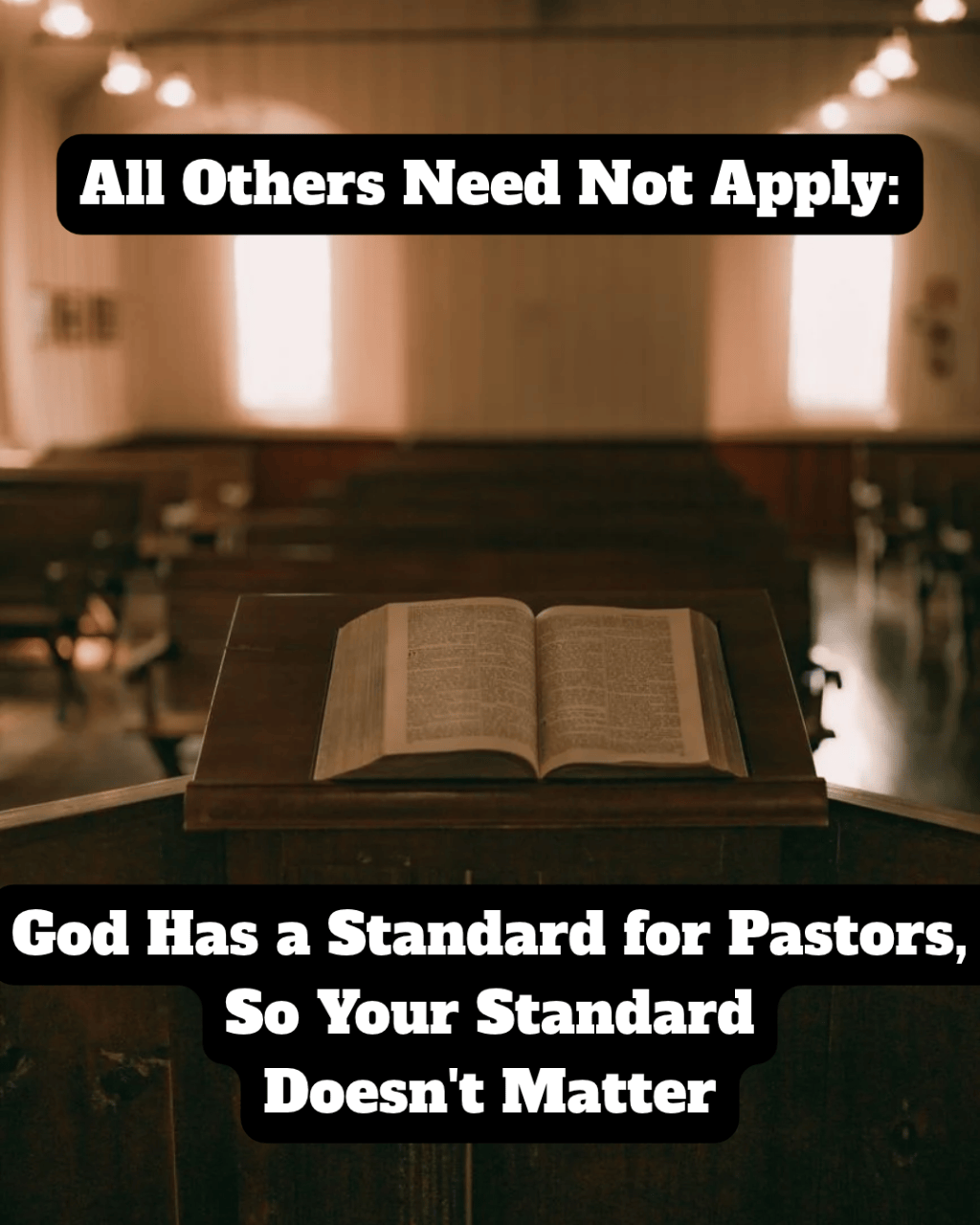
“Who are you to question my call to ministry?” Or, “Who are you to keep me from using my God-given gifts?”
I’ve heard these phrases or some derivative of them repeatedly over the years. It is a sign of the times, but it’s also a sign of where people believe authority lies.
This is the second installment of a series of articles that digs into qualifications for pastoral ministry. You can see the first article here. In it, I argue that the standard is real, not outlandish or unreachable. Today I’ll argue that God’s standard, not our subjective feelings, should govern who is called to ministry.
The Tyranny of Experience and Emotion
Historically, a tyrant was an absolute ruler who attained power wrongfully. The tyrant was an illegitimate ruler. Today we call anyone who wields more power than is rightfully theirs a tyrant, but I am using it in the historic sense.
Your experience and your subjective call to ministry cannot usurp God’s rightful reign. The Church is God’s Church, and He has given us qualifications in His Word as to who can be a pastor.
Your felt needs, emotions, perceived call to ministry, or anything else do not nullify God’s list of qualifications for ministry. The tyrant took the throne illegitimately. He took power that wasn’t really his. He claimed authority that wasn’t his. Someone who does not meet the qualifications to be a pastor, yet insists they are called to ministry, has let their emotions, feelings, and experience usurp God’s rightful claim on who belongs behind a pulpit.
Biblical Qualifications
We don’t have to guess at the qualifications for ministry. God, through the Apostle Paul, gave us a list of qualifications.
Paul worked to plant churches. He was not the pastor of these churches. He proclaimed the gospel openly, made disciples, proclaimed God’s Word, organized these gatherings, and then left trusted individuals in charge as he went on his way to work elsewhere. Paul returned, visited these churches, and wrote to them. But he left other people to lead these churches.
This is what makes the pastoral qualifications lists so interesting. These are lists Paul left leaders of these newly planted churches to help them choose who would lead these congregations.
Paul gives these men a list of character traits that qualify a pastor. This list is supposed to help them choose leadership. It serves the same function for us today.
It is a trustworthy statement: if any man aspires to the office of overseer, it is a fine work he desires to do. An overseer, then, must be above reproach, the husband of one wife, temperate, self-controlled, respectable, hospitable, skillful in teaching, not overindulging in wine, not a bully, but gentle, not contentious, free from the love of money. He must be one who manages his own household well, keeping his children under control with all dignity (but if a man does not know how to manage his own household, how will he take care of the church of God?), and not a new convert, so that he will not become conceited and fall into condemnation incurred by the devil. And he must have a good reputation with those outside the church, so that he will not fall into disgrace and the snare of the devil.
1 Timothy 3:1-7 NASB
For this reason I left you in Crete, that you would set in order what remains and appoint elders in every city as I directed you, namely, if any man is beyond reproach, the husband of one wife, having children who believe, not accused of indecent behavior or rebellion. For the overseer must be beyond reproach as God’s steward, not self-willed, not quick-tempered, not overindulging in wine, not a bully, not greedy for money, but hospitable, loving what is good, self-controlled, righteous, holy, disciplined, holding firmly the faithful word which is in accordance with the teaching, so that he will be able both to exhort in sound doctrine and to refute those who contradict it.
Titus 1:5-9 NASB
Shut Your Existentialist Mouth
Existentialism was a movement in the 19th-20th Century. Existentialists taught that human beings create their own meaning and purpose through personal struggle.
Søren Kierkegaard was the father of Christian existentialism and the premise was that absolute, objective truth does not exist. He emphasized the subjective inner man in the search for truth.
Now, when a person’s life does not measure up to the standards God sets in His Word, and they say, “Who are you to question my call to ministry?” something becomes obvious. They don’t believe in the objective truth of God’s Word. They behave like existentialists, emphasizing inner feelings and emotions. They must be called to shut their existentialist mouth and believe God’s Word.
God Calls His People to Question Your Call to Ministry
Why has God given qualifications for the pastorate? Is it not so that the church will appoint only people who meet the qualifications for that position?
Who are we to talk back to God?
Who are we to question His Word?
Who are we to trust a person’s subjective feelings about their call to ministry over God’s Word?
Trust the Lord and not yourself. Take these qualifications seriously.
Conclusion
Though a thousand unqualified people shed millions of tears at your feet, do not waver. God has given us His standard for those who would be pastors. Their tears and emotions don’t outweigh God’s Word.
This is difficult, but necessary. Honor God. Honor His Word. Don’t succumb to that sort of pressure.


Leave a Reply