
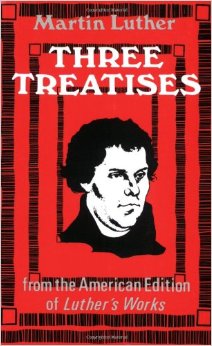
Few people, if any, have shaped Western Culture as much as Martin Luther. The Protestant Reformation came as a thunderbolt that seems to have changed everything. And, much of what happened in the early parts of the Reformation, especially in Germany, was greatly influenced by the three works that are found in this book.
In 1520 Martin Luther wrote three treatises that were foundational to what he believed. The treatises were “To The Christian Nobility of the German Nation”, “The Babylonian Captivity of the Church”, and “The Freedom Of A Christian”. All three of them carry a huge amount of historical significance, while at the same time being very readable and at times very stirring.
“To The Christian Nobility Of The German Nation”
This was an address to the Christian nobles in Germany that was written to convince them that the policies and practices of Roman Catholicism in Germany were ruining Germany. It was essentially a call to kick Rome out politically and give power to the German state. One of the more striking issues that looms large in this work is that of the “Priesthood of the Believer”.
“But that a pope or a bishop anoints, confers tonsures; ordains, consecrates, or prescribes dress unlike that of the laity, this may make hypocrites and graven images, but it never makes a Christian or “spiritual” man. Through baptist all of us are consecrated to the priesthood, as St. Peter says in 1 Peter 2:9, “Ye are a royal priesthood, a priestly kingdom,” and the book of Revelation says, Revelation 5:10 “Thou hast made us by Thy blood to be priests and kings.” For if we had no higher consecration than pope or bishop gives, the consecration by pope or bishop would never make a priest, nor might anyone either say mass or preach a sermon or give absolution. Therefore when the bishop consecrates it is the same thing as if he, in the place and stead of the whole congregation, all of whom have like power, were to take one out of their number and charge him to use this power for the others; just as though ten brothers, all kings and sons equal heirs, were to choose one of themselves to rule the inheritance for them all, — they would all be kings and equal in power, though one of them would be charged with the duty of ruling.” Open Letter to the Christian Nobility – Luther 1 1 Adapted from the translation of C. M. Jacobs (Works of Luther, Philadelphia: A. J. Holman Company, 1915), found online at: http://www.iclnet.org/pub/resources/text/wittenberg/luther/web/nblty-03.html .
What is it that separates one believer from another? What makes one a pastor over a flock of other believers? Luther argues that all believers are priests from Scripture and then states that it is the congregation that decides who will be their leader rather than the Pope or a bishop. All of the believers are equal, there is no barrier that exists between them. Yet, some are chosen to do the work of shepherding the flock of God.
The Priesthood of all believers becomes the reasoning for kicking Rome out of their midst. Rome had taken from Germany to pay for Rome and the people were hurting and, in Luther’s opinion, it was time for it all to be over. He was calling for the eviction of Rome.
The Babylonian Captivity of the Church
This address was a more angry attack on Rome. Luther accuses Rome of holding God’s people and the sacraments in bondage with the Seven Sacraments of the Roman Catholic Church. It was a means to keep people in what he called “the Babylonian Captivity of the Church”. He discusses the Lord’s Supper, Baptism, Penance, Confirmation, Matrimony, Orders, and Extreme Unction.
All three addresses have been massively influential in the Protestant Church, so you will notice things that are said quite often today within its pages. One of those things is that the only Sacraments that are really Sacraments are the Lord’s Supper and Baptism. The reason is the same one that Protestants give today. Jesus instated these two and no others and to include the others goes against the definition of a sacrament. A sacrament should have two parts. First is a promise. The second is a sign or symbol.
“It has seemed best, however to consider as sacraments, properly so called, those promises which have signs annexed to them. The rest, as they are not attached to signs, are simple promises. It follows that, if we speak with perfect accuracy, there are only two sacraments in the Church of God, Baptism and the Bread; since it is in these alone that we see both a sign divinely instituted and a promise of remission of sins.” – http://whitehorsemedia.com/docs/BABYLONIAN_CAPTIVITY_OF_THE_CHURCH.pdf
The promises in the Lord’s Supper are many, but one big one to use as an example is the remission of sins through the death of Christ. The sign of this promise is the wine/juice representing the blood of Jesus and the bread representing His body. Since the other five sacraments were not instated by Jesus and do not fit the definition of a sacrament they should not be thought of as sacraments.
Even though Luther agreed with the Lord’s Supper being given he disagreed with the meaning and manner in which it was given. There has been much written about Luther’s views of the Lord’s Supper, so this is easy to find. But he also disagreed with the priests not giving the cup of wine to the common people sitting in the pews. It was reserved for the priests only. It was called giving the Supper in one kind rather than both kinds. This is quite objectionable for Luther because the sign and symbol is for all believers. This also flies in the face of his belief that all Christians are priests. He is passionate on this subject, as he should be. Here is an example.
” I conclude, then, that to deny reception in both kinds to the laity is an act of impiety and tyranny, and one not in the power of any angel, much less any Pope or Council whatever.” – ibid
To Luther this was just one more way in which Rome held Christians in captivity. And it was to be overturned.
Baptism, though it was accepted as a sacrament by Luther, was also different from what Rome taught. There was no inherent justification in baptism. We are justified by faith alone, not by works. That is why Luther would say,
“Thus it is not baptism which justifies any man, or is of any advantage; but faith in that word of promise to which baptism is added; for this justifies, and fulfills the meaning of baptism.” – ibid
Luther felt that Rome had turned baptism into a work that had to be accomplished by the believer and thus attain salvation.
“Thus they have endeavored to make out of the sacrament a precept, and out of faith a work. For if a sacrament confers grace on me, merely because I receive it, then it is certainly by my own work and not by faith that I obtain grace; nor do I apprehend any promise in the sacrament, but only a sign instituted and commanded by God. It is evident from this how utterly the sacraments are misunderstood by these theologians of the Sentences, inasmuch as they make no account either of faith or the promise in the sacraments, but cleave only to the sign and the use of the sign, and carry us away from faith to works, from the word to the sign. Thus, as I have said, they have not only brought the sacraments into bondage, but, as far as in them lay, have entirely done away with them.” – ibid
The sacraments are to free us from our works and cause us to look and trust in the promise of God. Turning sacraments into works is doing the opposite of that.
I will not look at each sacrament, for I would like you to have something to read. But, I will say that modern day Protestants can gain much understanding from reading this treatise.
The Freedom of a Christian
Honestly, of the three treatises, I found this to be the most warming to my soul. Luther works out two very different ideas that are beneficial for the life of a believer. He lays them out in his thesis.
“A Christian man is the most free lord of all and subject to none; a Christian man is the most dutiful servant of all and subject to everyone.”- http://www.jmstanton.com/Docs/Martin%20Luther%20-%20On%20the%20Freedom%20of%20a%20Christian%20with%20lines.pdf
A Christian is found to be completely free of the bondage of sin and brought into a right relationship with God through the finished work of Christ. What a glorious freedom this is! Yet, at the same time Christians are called to live in service to others. He is the “dutiful servant of all”. What a wonderful thought!
Concluding Thoughts
There aren’t a lot of people out there willing to read these three treatises by Martin Luther, but I find that to be a shame. Works like these transformed our culture into what it is today. These works have done just that and have a second component to them. At times they can greatly stir the affections for Christ.
R. Dwain Minor


Leave a Reply